Citizen Science Programs
We are actively seeking volunteers to join our citizen science programs and help protect the Finger Lakes from invasive species—and we want you to be part of the effort! As a citizen scientist, you’ll serve as essential “eyes on the ground,” documenting target species across the region. Your observations play a critical role in early detection, which is the key to rapid response and preventing high-impact invaders from spreading and harming native ecosystems.
But these programs aren’t just about helping us—they’re designed to help you connect more deeply with the environment. Citizen scientists learn directly from professionals, gaining hands-on skills in species identification, ecological monitoring, and field techniques. Whether you’re curious about what’s growing beneath the lake’s surface or what plants line your favorite hiking trail, these programs offer a chance to explore and learn in a meaningful way.
Where does this take place?
Anywhere in the FLX!
Who can join?
Anyone—no experience needed!
Details for each citizen science program area are listed below.
Trail Survey Program
As part of our Trail Survey, participants are asked to hike local trails and record what invasive species they see with a mobile app. By taking part in our Trail Survey, you not only help the environment by helping us track invasive species, but you give yourself a chance to learn new skills!
Trail Survey Goals:
- Find where invasive plants are growing along our trails by surveying with your smartphone
- Use the collected data to prioritize invasive species removal

What would I be doing?
Volunteers will be hiking trails of their choice as many times as they would like from April 1st – September 30th. While hiking, you will note the invasive species you find using an app on your phone called ArcGIS Survey 123. This year, we are asking volunteers to look for twelve different invasive species in the Finger Lakes region. For your ease, we have provided a virtual training video, training slides, and species fact sheets below to get you started! Review these materials to be ready to go out on the trail; it’s quick and easy!
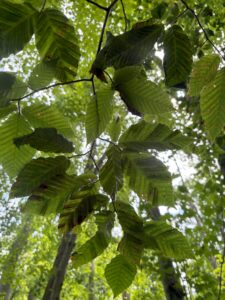
Beech leaf disease (sign of invasive nematode) on American beech
How to Join:
- Register Here for the 2026 Trail Survey Program
- Review our training materials below.
- Download ArcGIS Survey 123 and download our survey onto your device: TSP_Survey123_Downloading_Steps
- Hit the trail!
Benefits to joining the Trail Survey:
- Help the environment by stopping our worst invasive species!
- Learn new skills! Learn how to identify invasive species and use reporting tools on your phone
- Be more active! By getting outside and hiking on trails, you can exercise without having to go to the gym
- Get outdoors! Research shows that we spend 93% of our time indoors, and that being outside and interacting with nature can significantly help lower stress
The 2026 Trail Survey Program will run from April 1st – September 30th.
Due to species phenology, we will be updating our species lists, descriptions, and online resources every two months. Here are the species we are asking you to look for in August and September!
- Japanese knotweed
- Spotted lanternfly nymphs and adults
- Tree-of-heaven
- Beech leaf disease
- Golden oyster mushroom
- Japanese stiltgrass
- Mile-a-minute
- Phragmites
- Japanese angelica tree
- Oak wilt
2026 Training Materials:
We are also offering certificates to our volunteers to thank you for your time this season. More information is provided below:
Trail Tracker Certificate: Earn our Trail Tracker Certificate when you complete three survey sessions this season!
Trail Master Certificate: Earn our Trail Master Certificate when you complete five survey sessions this season!
For more information reach out to Laurel Williams, Invasive Species Education and Outreach Program Manager, at lwilliams@hws.edu.
Aquatic Survey (Macrophyte Survey Program)
As a Macrophyte Survey Program volunteer, you’ll serve as essential “eyes on the water,” helping document aquatic plant species across the Finger Lakes region. Your observations play a critical role in early detection, which is key to rapid response and preventing high-impact invasive species from spreading and harming native ecosystems.
Whether you’ve volunteered with us before or this is your first season, we invite you to join the 2026 Macrophyte Survey Program!
Macrophyte Survey Program Goals:
- Detect invasive aquatic plant species in Finger Lakes waterbodies
- Support early detection and rapid response efforts
- Help protect native ecosystems and recreational waters
- Engage community members in hands-on conservation science
What would I be doing?
Volunteers survey waterbodies of their choice from June 1st – September 30th. Participants use a rake toss method to collect aquatic plants and record what species they find using the free smartphone app ArcGIS Survey123.
You can survey from your personal dock, favorite fishing spot, kayak launch, or local boat launch; wherever you enjoy spending time on the water!
Volunteers are encouraged to survey as many times as possible throughout the season, but every survey helps. Even participating once can provide valuable data that makes an impact.
How to Join
- Register for the 2026 Macrophyte Survey Program
- Review the training materials and resources below.
- Download ArcGIS Survey123 and our survey form onto your device: MSP_Survey123_Downloading_Steps
- Attend a virtual or in-person workshop if interested
- Start surveying your favorite waterbodies!
Training Opportunities:
New to the program or need a refresher?
Finger Lakes PRISM staff will host a virtual training on June 3rd from 5:30-6:30pm and conduct workshops across the region alongside our partners.
Please register for any workshops you are interested in attending. In the event of weather-related cancellations or scheduling changes, updates will be sent directly to registered participants.
Benefits to Joining the Macrophyte Survey Program
- Help protect Finger Lakes waterbodies from invasive species
- Learn aquatic plant identification and survey techniques
- Contribute directly to regional conservation efforts
- Spend more time outdoors exploring local lakes and waterways
- Gain hands-on citizen science experience
2026 Training Materials:
- Aquatic Plant ID Slides
- MSP Training Slides
- How to Fill Out the FL PRISM Volunteer Hours Form
- How to Take Good ID Photos
- The above document leans more towards terrestrial plants, but contains similar information to taking good aquatic plant ID pictures!
- 2026 Macrophyte Survey Program Training Video
- Don’t have a rake? They are easy to build! Purchase the materials below.
- 2 Rakes: Expert Gardener Wood Bow Rake – Walmart.com
- 30 Ft of Rope: RELIABILT 0.375-in x 100-ft Braided Polypropylene Rope (By-the-Roll) AC1166R at Lowes.com
- Zip Ties: Utilitech 8-in Nylon Zip Ties Black with Uv Protection (100-Pack) SGY-CT23 at Lowes.com
- Electrical Tape: Scotch 0.75-in x 66-ft Vinyl Electrical Tape Black 4218-DL-4W at Lowes.com
- How to Build a Rake Video Coming Soon!
Volunteer Recognition:
To thank volunteers for their time and effort this season, Finger Lakes PRISM is offering participation certificates:
- MSP Explorer Certificate: Complete six survey sessions during the season
- MSP Master Certificate: Complete twelve or more survey sessions during the season
We will also recognize the top three volunteers who survey the most hours throughout the season. These volunteers will receive:
- A special social media shoutout
- Finger Lakes PRISM branded items
These small tokens recognize the big difference volunteers make in protecting the Finger Lakes region.
MSP Duration:
- June 1st – September 30th
Additional Information
All training materials and program resources will be available on June 1st.
Huge thank you to all of our co-hosting partners; this program would not be possible without their support!
Whether you’re an avid boater or simply looking for a meaningful way to protect local waterbodies, the Macrophyte Survey Program is a great opportunity to connect with nature and give back to the Finger Lakes.
For more details, training materials, registration, or questions, visit our website or contact Invasive Species Education and Outreach Program Manager Laurel Williams at lwilliams@hws.edu.
 |
 |
 |
|
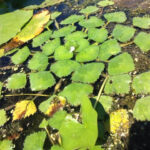
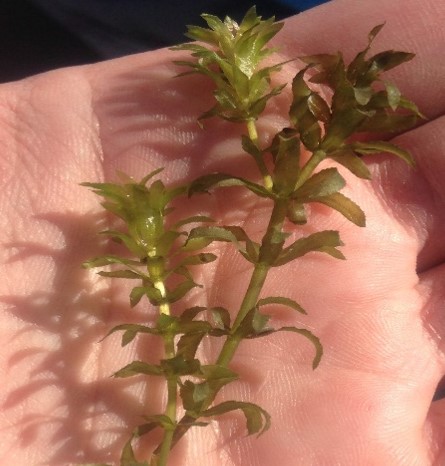
Water Chestnut (Trapa natans) |
Hydrilla (Hydrilla verticillata) |
Starry Stonewort (Nitellopsis obtusa) |
Hemlock Woolly Adelgid Survey
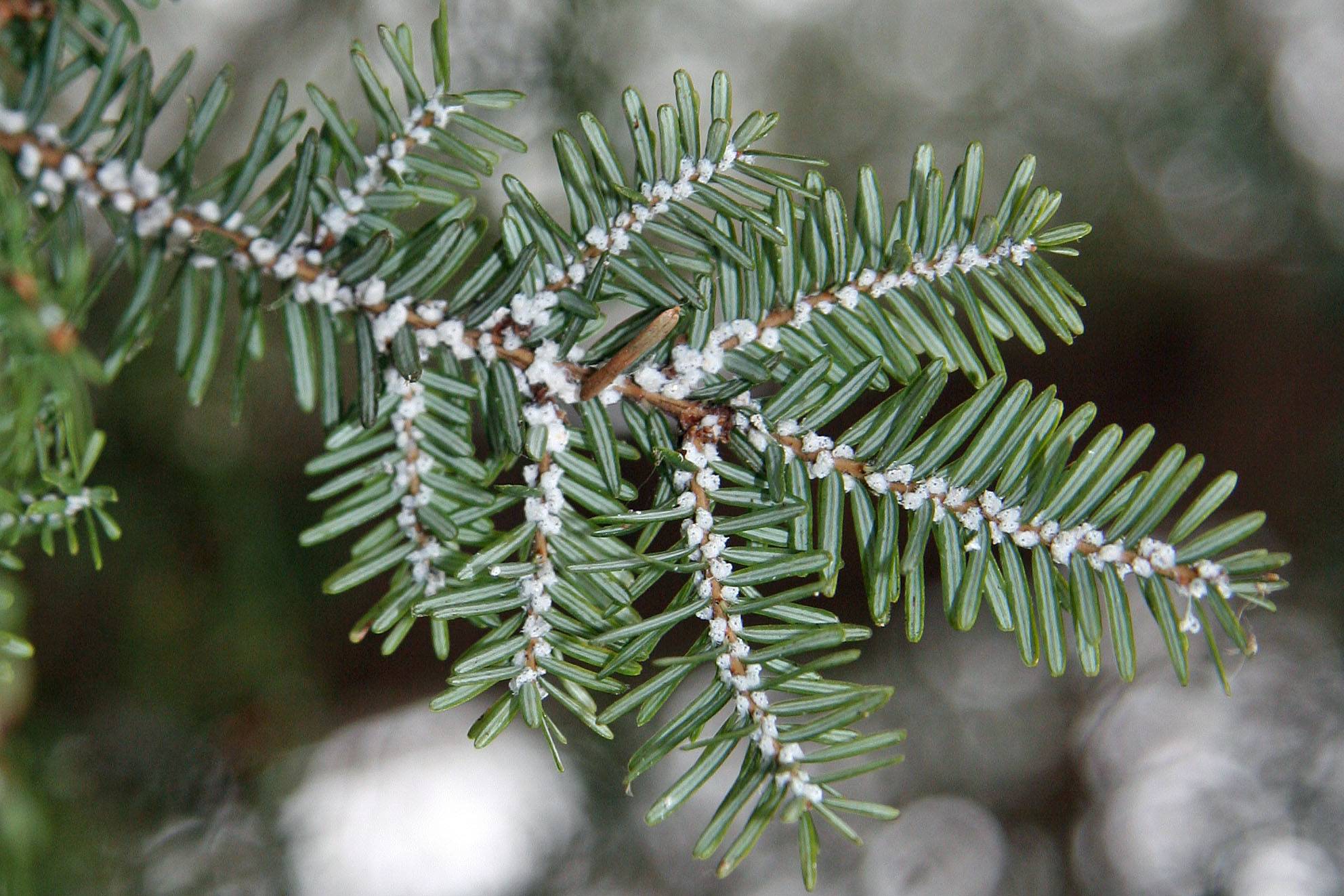
HWA ovisacs on a hemlock branch.
Hemlocks are under threat! We are seeking dedicated volunteers to join us in the fight against one of our most destructive (and smallest) invasive species, the Hemlock Woolly Adelgid (HWA). This tiny insect is wreaking havoc on eastern hemlocks, the Finger Lakes region’s most valuable tree species.
As a citizen science volunteer, you can help us fight HWA by surveying on your own around trails and parks in your area, or by attending one of our in-person workshops. With a greater understanding of HWA’s distribution, we can better plan efforts to limit its spread and treat it before its too late!
-
Workshops – Hands-on field sessions to learn how to survey for HWA and identify hemlocks, led by our team and co-hosted by local organizations in your area
-
Virtual Training – Virtually learn how to survey for HWA and identify hemlocks on your own time.
2026 Training Materials:
Email lwilliams@hws.edu for more information.