2025 Trail Survey Program – Season Recap
The 2025 Trail Survey Program Has Concluded!
We cannot thank everyone enough for your hard work! Even with a delayed start, you delivered an outstanding volume of observations from trails across the Finger Lakes.
Your commitment as community scientists plays a crucial role in advancing invasive species research and management. The information gathered through the Trail Survey directly informs how we shape and adjust our management strategies, helping us better address invasive species impacts throughout the region.
Thank you once again for your enthusiasm, support, and meaningful contributions!
Season Breakdown: The Official Standings
The final count is in…
This season, our dedicated team of 14 volunteers submitted a total of 257 survey points!

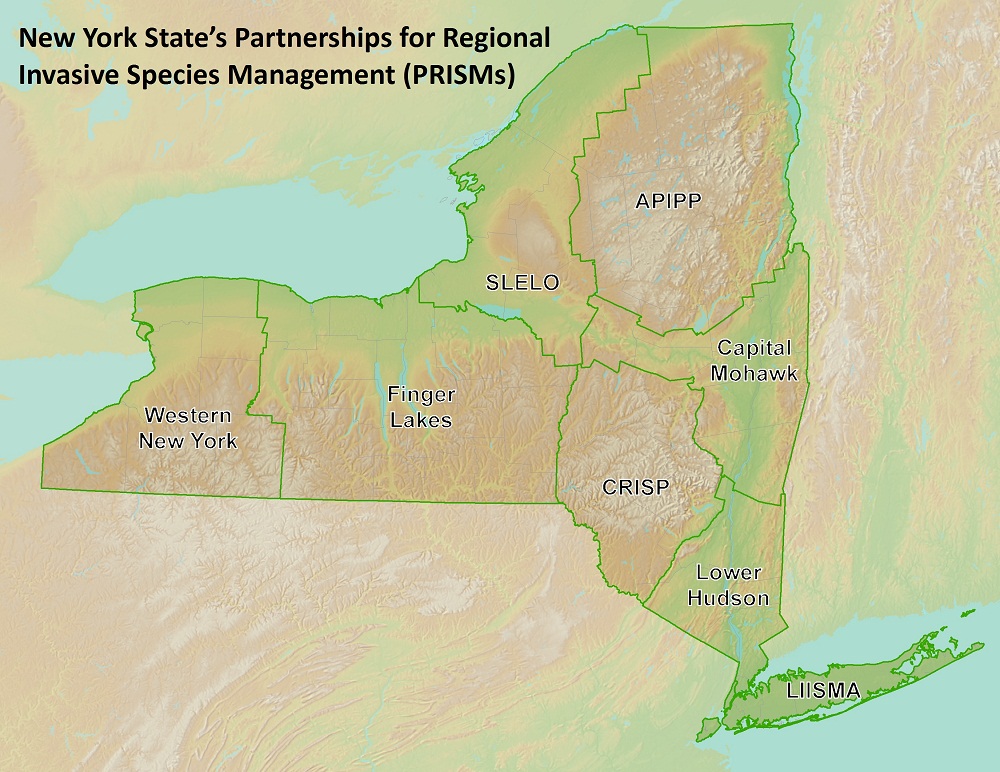
Depicted above: Invasive species detections from the 2025 TSP season.
Observation Distribution by County
- Cortland: 5
- Chemung: 11
- Livingston: 13
- Madison: 11
- Monroe: 131
- Ontario: 20
- Schuyler: 16
- Tompkins: 8
- Tioga: 25
- Steuben: 7
- Wayne: 8
This helps us visualize survey distribution across the region, making it easy to spot areas of high and low activity. A big shout-out to Monroe County volunteers for submitting the highest number of surveys! Although these locations fall outside our PRISM region, we also received two additional survey submissions from Allegany County. Of the 257 surveys received, 119 included reports of detected invasive species!
This season, our surveys revealed which invasive species are most active and which remain rare. Swallow-wort led the pack with 56 sightings, confirming its strong presence across the region. Beech Leaf Disease also made a notable appearance with 24 reports. With only 6 sightings, Japanese Stiltgrass may be flying under the radar for now, but its ability to spread quickly means it’s definitely not off our minds!
Species Report Frequency
- Beech Leaf Disease: 24
- Japanese Stiltgrass: 6
- Japanese Knotweed: 9
- Slender False Brome: 16
- Swallow-wort: 56
- Tree Of Heaven: 8
Thankfully, there were 0 reports of Mile-a-Minute, one of our region’s highest priority invasive species. Other species that were never observed through the trail survey were Golden Oyster Mushroom, Japanese Angelica Tree, and Spotted Lanternfly. These zero detections are encouraging, suggesting that either these species have not yet gained a foothold in the surveyed areas or that current prevention and early detection efforts are working. Continued monitoring will be essential, but for now, it’s a positive sign worth celebrating!
Want to explore some of our volunteers’ survey data?
Take a virtual tour of the region and see first-hand the work our volunteers have done this season! Click the link to our StoryMap to view images of invasive species, track where they were found, and get a closer look at the areas you all surveyed.
By analyzing your survey data, we can determine not only what species are present on the trails, but also what has not yet reached an area through non-detections. This information helps environmental professionals understand which areas are currently free of certain invasive species and do not require immediate management, while also providing valuable context about potential future spread if these species expand into those regions.
This season, with a maximum of 11 species that could be reported not present at any given point, we received 2,656 species non-detection reports. Considering our season was shorter than usual, this is an impressive accomplishment!
Trail Survey Program Certificates
This season, we introduced a new challenge to recognize the dedication of our volunteers: completing at least three surveys earned participants Trail Tracker status, while those who completed five or more achieved Trail Master certification. These milestones highlight not just time spent on the trail, but a deeper commitment to protecting our region from invasive species.
We’re excited to share that three of our fellow trailblazers reached Trail Tracker status, and five volunteers went above and beyond to earn the title of Trail Master.
Trail Trackers
- Elizabeth DiCesare
- John Ghertner
- Jill VanDewoestine
Trail Masters
- Jacalyn Malinowski
- Jeff Gennarelli
- Jill Carter
- Kyle Rosenthal
- Thomas Steele
A special shout-out and heartfelt thank-you to these volunteers for their outstanding commitment to the trails this season.
So What Now?
Did you enjoy being part of the Trail Survey Program? If so, stay tuned for details about our upcoming Hemlock Woolly Adelgid (HWA) Survey Program!
Beginning in January, we’ll be offering a virtual training covering HWA’s natural history and how to identify signs of infestation, followed by multiple hands-on, in-person workshops throughout the region.
If you’re curious about the tiny insect threatening our hemlock forests, keep an eye out for our next newsletter arriving in early December, it will have everything you need to get involved.
Thank you to all of our volunteers for a wonderful season – we’ll see you back on the trails soon!
Questions? Email lwilliams@hws.edu
Subscribe
If you enjoyed this article, subscribe to receive more just like it.